Showing posts with label Atrocitus. Show all posts

Tuesday, 18 February 2014

Green Lantern: Secret Origins - Revision or Retcon?


Without a shadow of a doubt Geoff Johns is the name most famously associated with Green Lantern since Deny O'Neil and Neal Adams had their controversial run together on the title in the 1970s.  Johns is credited with producing a series that is singularly respectful of the entire mythos that came before it.  He managed to unite Lantern fans of every era, which is no small feat considering the fall out between Hal Jordan fans and supporters of his replacement, Kyle Rayner, after the Emerald Twilight saga.


Two things are clear from the outset of Johns' long relationship with Green Lantern; 1. he knew his stuff, and 2. he had a plan.  To say Johns knew his GL history is an understatement.  He references back to the Silver-Age and the very earliest appearances of Hal Jordan.  Substantial elements of the character's recounted origins can also be attributed to the Emerald Dawn (vol. 1 and 2) mini-series' penned by Keith Giffen and Gerard Jones in 1990/91.  And while Johns is clearly a Hal fan he is shown a great deal of respect by the comic book community for preserving the back story of Kyle that played out through the 90s.  Even more significantly (despite being publicly lambasted by its original creator) he hangs much of the current mythos around a short story by Alan Moore that appeared in Tales of the Green Lantern Corps Annual #2 .


Which brings me in a neat little segue to this, the chosen subject of my second contribution to the Super-Blog Team-Up.  This time round, as you'll already know if you've been reading the posts of my uber talented fellow Super-Bloggers, we have elected to tackle the subject of retroactive continuity.  The longer a comic book character exists, the more likely it is that their history will be rewritten in order to tell original, compelling stories.  How many times could you read about a rocket leaving the orbit of an exploding planet with a lone baby as it's only occupant if creators just retold the same story over and over again, panel for panel?  Yet the origin of Superman is one of the most well-known of all comic book stories. While one key point remains the same, the events leading up to the super child's launch, the manner of his journey, the nature of the very rocket he travelled in have been tweaked and successfully re-imagined many, many times.


Perhaps less well known is the story of an Earthman's induction into the intergalactic peace-keeping force that is the Green Lantern Corps.  Even so, in the 55 odd years since Hal first burst onto the scene in the pages of Showcase #22 there have been various accounts of the dying alien who bestowed his ring of power on a fearless test pilot.  Geoff Johns set out to tell the tale in unparallelled detail across a seven issue arc of Green Lantern called, somewhat unsurprisingly, Green Lantern: Secret Origins.  In this feature I consider the question, 'Is Secret Origins a retcon in the truest sense of the word? Or, given Geoff Johns fabled reverence for all that has come before, is the book instead better viewed as a revision of GL stories past?'  As I began my exploration of the title I wondered to myself if Johns deserves his reputation as the man who left history intact.


It would be very easy here to get lost in a sea of high concept BS. Does Secret Origins reflect the spirit of it's predecessors?  Does the comic maintain its integrity as an original work?  Instead I thought it would be a lot more fun to geek out on some comics!  And there is nothing a comic fan loves more than over analysing ever minute detail of their favourite publications.  In fact I have a feeling the post is going to have more in common with a child's 'Spot the Difference' puzzle than some of the quality literary dissertations on our sequential art medium.


So let's have a look at the evidence.  "Exhibit ,1 Your Honour".  In the aforementioned Showcase #22 and in Green Lantern #1 (vol. 2) released the following year, Hal's first contact with his emerald hued future took place while sitting in flight simulator cockpit.  The wingless (virtually 'planeless') machine is scooped up bodily by green energy emanating from fatally injured Abin Sur's power ring.  It's not a sexy image by any means but there is something enjoyable in the sight of a future cosmic hero being held aloft in a giant metal contraption.  Johns forgoes this original script choice for the more photogenic flying man sans bathtub.


I like to think he and artist Ivan Reis make a nod to it in the panel immediately before the ring's entrance with Jordan sitting in the wreckage of an old plane that has been well and truly grounded.  I could be clutching at straws here, of course.  VERDICT - RETCON.


Hal's heroknapping leads us swiftly to the often asked question, "What the heck was Abin doing in a spaceship in the first place?"  A Green Lantern's power ring enables its wearer to survive flights across deep space unaided.  There should be no reason for the unlucky GL to have required a craft to transport him.  For many years the comics were silent on the matter.  It took Alan Moore to come up with the definitive answer in his short story, 'Tygers'.  Moore's theory was that Abin Sur received a dark prophecy from Qull, a member of a villainous group called The Five Inversions who were held captive by the Corps on the planet Ysmault.  The prophecy claimed that Abin's power ring would fail him a a critical moment.  The ship was a backup plan, much like Simon Baz's gun is in the GL universe today.  So far, so good.  Geoff Johns lifts directly from Moore's story having the failure of the tragic alien's ring foretold by Qull.  Even the ship itself is reminiscent of the one designed by Kevin O'Neil in 'Tygers'.  If we stopped the tape here we'd be able to call this one VERDICT - REVISION.


But when the Green Lantern got into that ship and left Ysmault, the two histories begin to spin in very different directions.  Much like in Showcase #22, 'Tygers' sees the ship pass through a cloud of yellow radiation that neutralises both the mechanics of the vessel and it's occupants ability to wield his power ring.  The moral is that had Abin Sur put his faith in his ring alone he might have been able to test for the radiation zone before he entered.  It's not a particularity definitive conclusion if you ask me.  Geoff Johns takes things from a maybe to a definitely.  The Lantern did not leave the prison planet by himself.  Armed with the prophecy of the Blackest Night, Abin took one of the Inversions with him hoping to extract further information.  The consequences of his foolhardy decision were disastrous.  A Green Lantern's ring is powered by the strength of the wearer's own willpower.  With Abin expecting the ring to betray him at any time, the will he normally commanded had begun to ebb away.


His construct confining the Inversion, Atrocitus, was weak.   Atrocitus was able to break free of his manacles and attack his captor, causing the starship to crash in the process.  In Johns' version of events it was still yellow that ultimately brought about Abin's downfall but this time it was the yellow fear within his own soul instead of any external physical catalyst.   VERDICT - RETCON.


One of the most important relationships explored in Secret Origins is the first contact between Hal and his arch nemesis, Thaal Sinestro.  The villain was introduced as one of Green Lantern's earliest Silver-Age foes in Green Lantern #7.  His origin story was laid out in detail during that very first appearance.  He had been considered the greatest Lantern of them all before a thirst for power swayed him from the path of justice.  Hal was tasked by his masters, the Guardians of the Universe, to defeat Sinestro and this was the circumstances under which they first met.  ...So that was one version of events, one that remained in continuity for a great many years. 


Then came Emerald Dawn.  And with it a time line that saw Jordan recruited during the Korugarian's tenure as a Lantern.  In fact, Sinestro was set the task of training the newest GL of sector 2814 in law and, more importantly, order.  Geoff Johns took the opportunity to tease at this concept in more depth.  Green Lantern volume 4 was his plaything for nigh on decade and giving him plenty of opportunity to work out what makes Sinestro tick.  Under his pen the infamous Corpsman was sent to Earth for a very different reason, to investigate Abin Sur's death.  But Sinestro being Sinestro, he felt obliged to try and educate Jordan along the way.  The thought that someone as reckless as Hal should wield a power ring at all irked him immensely.  There isn't a version of the history imaginable were the veteran does not insist on schooling the impudent rookie on life as he sees it.  Not that Hal makes for a very receptive student!  VERDICT - REVISION.


Emerald Dawn is responsible for introducing another theme that has become central to Hal Jordan's character.  It is the very reason he "can overcome great fear".  As a young boy he worshipped his father, Martin Jordan, another fearless test pilot.  Witnessing his father's death in a plane crash changed his life forever.  In a situation where many would retreat from the way of life that had cruelly taken his idol the young Hal instead pushed himself to emulate the elder Jordan and confront his deepest fear head on.


In Emerald Dawn Martin's death was all too avoidable.  His plane had taken damage and his flight crew urged him to bail out.  The pilot's bravado and self-confidence pushed him to try and land the plane in one piece but it was not to be.  The same attitude can be seen as the root of Hal's own misery in ED when he landed himself in jail on drunk driving charges.  Secret Origins opens with a similar scene of devastation but in this version Geoff Johns sees fit to put a more heroic spin on events.  Martin Jordan's fighter jet again develops faults but he is urged to keep it in the air in front of observing investors.  Realising the plane will go down in any case Jordan sacrifices his own safety to guide it away from the watching crowds thus ensuring the loss of life was his alone.


As before, it is the characteristics of these final moments that are passed on to his son, fundamentally shaping the boys future.  VERDICT - REVISION.


Told across Green Lantern #5 (vol. 2) and Justice League of America #14 (vol. 1) the story of Hector Hammond is a very interesting one.  Portrayed as super-cool to the point of slimy, Hammond has wealth, power and the attentions of one Carol Ferris, sometime paramour of both Hal Jordan and Green Lantern (GL is famous for causing romantic competition for his own alter ego back in the Silver-Age).  The secret behind his success transpires to be a radioactive meteorite he had stumbled across.  He used the space rock to evolve four scientists with futuristic intellects and forced them to invent things for him and to do his bidding against their will.  When the emerald gladiator foiled his plans he turned the meteorite on himself to boost his own mental abilities far beyond that of a normal human.


His Silver-Age personality is  painstakingly recreated in Secret Origins.  As the reader we are left with no doubt that this is the same character as appeared in the original comics.  He even has a brief liaison with Carol before she thinks better off it.  It is only the circumstances of his latest incarnation that have changed.  Hector is now a aeronautics consultant called in to examine the remnants of Abin Sur's ill-fated vessel.  As a result of his own arrogance he is exposed to the fuel source of ship which is, of course, a radioactive meteor and he immediately develops telepathic abilities.  In both retellings an unfortunate side effect of his exposure comes in the form of a grotesquely enlarged cranium.  On the back of how faithful Geoff Johns' take on Hector's character was to his Silver-Age introduction I would love to mark this one up as a revision but the actual narrative is so wildly different that I have to admit there can be only one possible outcome.  VERDICT - RETCON.
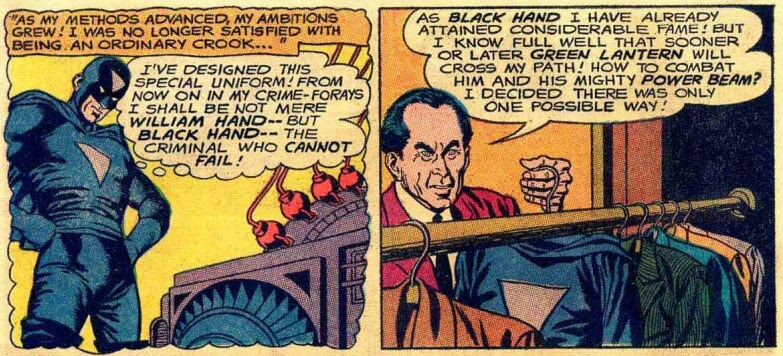

The last story element of Green Lantern: Secret Origins that I want to look at in some detail is the introduction of Black Hand.  Readers of my Black Hand pictorial blog will be aware that the Silver-Age depiction of William Hand was that of a clever crook with a love of knowledge, planning, inventions and, for some unknown reason, proverbs.  He created a device that could absorb Green Lantern's power and use it against him.  Another little referenced but very interesting point in the context of our discussion is that he was the odd one out in an otherwise honest, upstanding family.  In later years, particularly the 80s and 90s, Black Hand became a pastiche of himself.  A figure to be derided.  A villain who was destined to be defeated by the hero of the hour.  Given that William Hand became the single greatest threat to the Green Lantern Corps' existence during the Geoff Johns run it is a safe bet to call this one in advance as VERDICT - RETCON.


In SO Hand is the youngest son of a funeral home director.  He is once again at odds with the rest of his family but not because of criminal leanings.  This William Hand has a morbid fascination with death that is just plain creepy.  He is central to the prophecy that Abin Sur learnt from Qull concerning Blackest Night for he contains within him "the doorway to absolute darkness".  The device that Silver-Age Black Hand built to absorb the Green Lantern ring power has been retconned into a creation designed by Atrocitus to pull the Black energy out of William.  It only fell into the boy's possession during a scuffle between the Inversion and his GL opponents.  That Black Hand would later turn the device against the Lanterns was an unforeseen consequence.  As I've said already, VERDICT - RETCON.


All in all, the results have been wonderfully inclusive.  Secret Origins is a bridge of sorts between old and new.  It was, of course, written as a vehicle to further develop Johns' Green Lantern saga.  In this sense it is a prequel to the DC universe crossover event Blackest Night.  It is as much about the origins of Black Hand and Atrocitus as anything else, explaining how their past fits into the big picture.  But it is so much more than that.  The book is Geoff Johns' love letter to the past.  It has a timeless quality that feels like 50 years of continuity have been carefully preserved for future generations.  Most retroactive storytelling stamps all over the past with big hob nail boots.  Forget what you thought you knew because it didn't happen.  Green Lantern: Secret Origins has a unique trick of gently implanting on your memory, just for a moment,  a feeling that the history of the characters we encounter within its pages has always been this way.


****

So now you’ve read issue #2 of this spectacular SUPER-BLOG TEAM-UP crossover event, go check out these other amazing blogs to learn some more about the real stories behind the retcon...

Links (going live throughout Wed, 19 Feb):


#3 Longbox Graveyard: Retcon: Roy Thomas And Earth-2

#4 Between The Pages: Good Cowboys Always Shoot First

#5 Bronze Age Babies: Was The Vision Really Carrying A Torch?

#7 Superhero Satellite: RETCON: Crisis on Continuity Earths


Thursday, 1 August 2013

Construct of the Week #26


Remember back when Red Lanterns were scary?!
 
Generated by: Atrocitus

Construct: Mera, Queen of Atlantis

 
Appeared in: Green Lantern #54 (vol.4), 2010


Monday, 4 March 2013

B’ZZD REVIEW – RED LANTERNS #16


Brightest:
- Possibly due to his reluctance to completely relinquish the hold on his human side, Rankorr has the unique ability among the Red Lanterns of generating constructs.  Unlike the Green Lanterns Corps he does not have complete control of his creations.  He is attacked by a giant manifestation of his late grandfather made real by the insecurities of his own mind.  He realises the power he possesses and refuses to fall for Bleez’s seductions when she tries to manipulate the male Lantern so as to share his dubious gift.  She would make a formidable force if she managed to couple her singularly venomous rage with the potential to produce deadly weapons with a mere thought .
- Another exciting element of Red Lanterns #16 is the hook of slowly introducing the Inversions again.  In this issue they confront Ratchet who stumbled into their lair.  They are hugely ominous.  Peter Milligan has excelled himself in conjuring a dread around these creatures that leaves us with little doubt of the danger they pose to Atrocitus and his followers.   And with the sudden appearance of Krona’s ghostly projection on the final page I am at last on board with the cliff-hangers in this book.  I want to know what comes next.
Blackest:
- The art was a bit ragged at times.  It had none of the horror that we have been spoiled with by Miguel Sepulveda.  The fill-in penciller was Andres Guinaldo.  He didn’t seem overly familiar with the characterisation we’ve had previously.  Rankorr and his compatriots lack their usual menace as do the Inversions.  I was slightly confused when there appear to be six members to the notably named the ‘Five Inversions’.
- The Manhunters.  I can’t quite explain this one which I realise is of very little use in a written medium but there was something that just seemed a little off.  They chatter witlessly like some two-bit henchman from a Batman book.  Like one of the Riddler’s goons.
Beware its power…
- The original Sepulveda cover is staggering.  Atrocitus cuts the figure of a tyrannical war lord, clutching an enflamed Green Lantern flag - or Guardian tabard perhaps!  His terrifying Manhunter army fly in formation behind him.  They stretch out into the distant and each one brandishes a decapitated skull.  Explosions of blinding red and green energy light the sky behind them all.  This is a cover that demands attention.


Sunday, 13 January 2013

GHOST IN THE MACHINE – RED LANTERNS #15

 
Red Lanterns #15 is a continuation of the ‘Rise of the Third Army’ event currently spanning all four of DC Comics’ Lantern titles.  I had high hopes for the issue after the compelling read that was RL #14.  Atrocitus had travelled to Ryut to raise an inorganic battalion of Manhunters to stand against the ever increasing forces of the Guardians of the Universe.  It occurred to me that this might not be as easy as it sounds, and sure enough Red Lanterns leader runs into one or two problems along the way.

The book does much to expand on the individual personalities of its cast.  In recent months writer Peter Milligan has successfully taken the Red Lantern Corps from a collection of mindless super-violent slaves to a co-operative whose members bare distinct characteristics.  They are bound together by rage and revenge but how the emotion affects them is often manifest in very different ways.

Unfortunately, as explored in my recent examination of ‘Rise…’, this is another book that does very little to push the event itself forward.  The thrust of the narrative is engaged with two elements.  The first follows Atrocitus coming to terms (again!) with the Manhunter’s genocide of his people, and using his blood magic powers in an attempt to control his android enemies.  The second follows Rankorr on Earth in the company of Bleez were they are in pursuit of the man who murdered his grandfather.  Rankorr spends most of his time trying to come to terms (again!) with his role as a Red Lantern.  He meets his brother who has turned to alcohol, and also the policeman who he injured when the red ring first selected him.
 
 
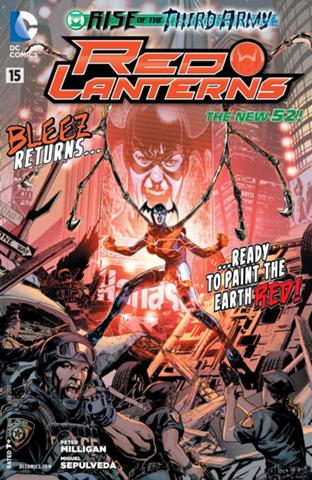
As more of a by the way than an actual criticism I’d like you to take a quick look at that cover were Bleez has cut a swathe of destruction across a big American city, causing chaos for police SWAT team and local law enforcement.  -- Doesn’t happen.  Not even a little bit.  I’m used to covers taking an artistic licence with the interior storytelling but this one I don’t get.  Bleez is not the central figure in this story and the closest she comes to fulfilling the scene you are looking at is to grab one ne’er-do-well by the head in the English countryside.  She’s not even particularly angry at the time (not for an agent of rage anyway).  I’ll grant you there are two police officers looking on at the time.  I mention all this as an aside really.  Some people love their covers but for me they take a firmly second place to content and storytelling.

Elsewhere Dex-starr is still smarting from the punch on the nose he received from Stromwatch’s Midnighter back in issue #10 and is taking it out on anybody with a chin spike!  And back on Ysmault the rest of the Red Lanterns speculate on why their power battery remains weak little realising the answer is below their feet.  In what for me is the most exciting panel of the whole book, Miguel Sepulveda gives us a spectacularly spooky rendering of the Inversions that captures the horror of Kevin O’Neil’s original drawings perfectly.  I have contemplated doing a commentary on Alan Moore’s Tygers here at Flodo’s Page for a while now and this great image has cemented the need in my mind.  Geoff Johns, Tomasi, Milligan and the rest have taken a little piece of Green Lantern history and turned it into a legend… so watch this space.

 
Back at the RL ranch things aren’t running so smoothly either.  Years before Atrocitous had stashed the bodies of the Manhunters in readiness for a time when he would have need of a fighting force.  He uses the blood of a native predator to retrieve them.  I took it that this creature caused Atrocitus to see hallucinations of his tortured past but I could be reading this incorrectly.  In either case the Manhunters appear but they are lifeless.  I have an issue with the look of the robots in Red Lanterns.  Visually it seems that their faces have rotted away to reveal a Terminator type skull underneath, complete with rows of uncovered teeth.  Please correct me in the comments below if I am wrong but surely the whole point of these characters being introduced is that there are 100% inorganic and therefore have no flesh to rot.  In my mind they should look in the same state of repair as the day they were buried.  I feel like Sepulveda’s effort to create dreadful images has led him in this case to overlook the basic premise of the story.

 
With the power battery being so weak Atrocitus has to use hemoglobin ripped from his own jugular to perform the blood magic that fires the androids up.  He assumes they will bend to his will and so no-one is more surprised than the Red Lantern leader when instead they follow their previous prime directive, “No man escapes the Manhunters”.  In the final splash page they pound him with energy blasts and we can see his skeleton outlined by his brute form.  Alas, this isn’t the cliff-hanger it could have been considering we’ve already seen him in the vision from Green Lantern #11 leading the Manhunters into battle.  I’m going to bet he wriggles out of this one faster than Adam West escapes a death trap at same bat-time, same bat-channel.

And that, as I mentioned above, highlights the whole problem I have with Red Lanterns #15 (and the #15 issues of the other lantern titles too); I was sold an event and I tweeted heavily about #ThirdArmy before it was published.  I feel like I have helped over-hype something that is more of a continuing story arc than an event in the classic sense.  The inclusion of the Manhunters is a great concept but I am eager to get into the thick of the action.  Atrocitus’ role in this book could have been covered in a few pages and Rankorr’s could have been left for another time or, as is my preference, should have taken place several issues ago.  At this stage, with only one more month to go, we should be up to our ears in evil minions and kicking some alien bad-guy ass from here to sector 3600!


Thursday, 13 December 2012

PICK UP THE BONES – RED LANTERNS #14


Fourteen months in and I finally feel like I’ve turned a corner with Red Lanterns.  Out of the four titles in the shared lantern universe this one seems to be benefiting most from the Rise of the Third Army crossover.  For a start it is the only book that shows any character development of the Thirdite creatures themselves.  I guess Peter Milligan has an advantage over other writers in that he spent the best part of a year struggling to give personality to a mindless Red Lantern Corps.  Who would have predicted in the early stages of the run that Atrocitus would eventually utter the immortal words seen in this issue, “I sense that you are the most intelligent and trustworthy of my Corps, Ratchet.”?  Now that he has actually achieved sentience for the RLs he seems to be finding it a straightforward matter to chart a development for the Guardian’s own mute army.

I never expected to be in a position where Red Lanterns is not sitting at the bottom of my GL stack but I have no qualms in admitting that this book is considerably better than Green Lantern: New Guardians #14 released the previous week.  I’d even take my compliment a step further.  RL #14 has the feel of a Gerard Jones era GL book.  The characterisation is strong, the narrative is reflective without being laboured and, in terms of the storytelling, nothing can be taken for granted.  Sure, dialogue is a tad clumsy here and there but it comes across more as charming than stilted.  This is a vast improvement on earlier issues in my mind.

The story opens on the rage corps swamped in Thirdites and giving as good as they get in hand to hand combat.  Even to hold their own in this scenario is a great deal more than the Green Lantern Corps have achieved up until now.  Of course, they are helped by the fact that Atrocitus has apparently developed the powers of Atom Smasher.  Either he has turned into a giant on the first splash page or his corps have been attacked by a battalion of Third Army smurfs.


I mentioned in previous reviews that Miguel Sepulveda’s art sets a great tone for what is essentially a horror comic posing as an anti-hero book.  I’ve also mentioned how he appears to have thrown out the style notes that would have been drafted for the crossover.  Well, now he has also thrown out the long-established rule book on form and perspective too.  Rankorr continues to show his conflicted human side by having doubts about killing a creature that had only just been transformed.  In the dialogue this is attributed to the victim’s eyes not having been changed with the rest of her, which fits in nicely with everything we have been shown previously.  But Sepulveda unnecessarily telegraphs her tragedy by drawing her with a distinguishable hairstyle that is not at all in keeping with our understanding of the Third Army’s transformation.


On the whole, however, the art is to be commended.  It is brutal and bloody when needed and the dramatic stylised panels are much clearer than they have any right to be given the amount of viscous flying around the place!
Atrocitus carries one of the corpses back to his home world for study and applies a combination of science and magic learnt over the course of many centuries to divine that his enemies were spawned by the Guardians in order to conquer the universe.  He realises his corps is vastly underpowered for a successful confrontation with the Oans and so he sets each of them a mission of revenge which will draw strength for their red power battery.  The book shows a rare glimpse of humour when Bleez  wisecracks about being typecast as she is instructed to seek out crimes of passion.  Milligan has found his voice and is able to utilise light and shade in a much more effective way than was the case five and ten issues ago.  He is no longer bogged down in the overtly philosophical burdens of his agents of vengeance.
As all of this was happening the lantern’s magic was having unexpected side effects on the subject of their recent autopsy.   In a further example of Milligan’s improved sense of balance a terrifying panel of a rat being sucked into the corpse’s remnants is juxtaposed with Dex-Starr, the rage kitty, giving a goofy shrug at its disappearance.   What then follows is the creation of a monstrous beast that is part rat and part skeletal spider.  It took a combination of Atrcocitus’ blood magic and Rankorr’s ring construct to eventually defeat the abhorrence.  I enjoyed Milligan’s exploration of the skill that Rankorr possesses which is common amongst Green Lanterns but unique to him within the Red Lantern Corps.  This definitely opens the doors for some intriguing storylines in the future.


In order to exorcize the inner doubts that hold him back from fulfilling his lantern duties Rankorr is ordered to Earth to have revenge on those who first enraged him.  He quickly realises that the planet of his birth can never be his home again.  Meanwhile Atrocitus is facing his own demons on the barren wasteland of his destroyed native planet, Ryutt.  His plan is to take control over the robotic Manhunters who slaughtered his species and turn them against their former masters.  He presumes the Guardian’s minions will not be able to forcibly induct an inorganic foe into their army.  Things take a turn for the worse when his memories of that fateful day seemingly become reality.  Ryuttians are brought to life before his eyes before being horribly slaughtered by the Manhunters all over again.  It remains to be seen how and why this tragic event is taking place.

The pacing of the issue was excellent.  An incredible amount of action is crammed into these twenty pages without feeling rushed or under-explored.  The crossover event and the story of the Red Lanterns themselves are both progressed with losing out to the other.  If the book can maintain the same level of quality next month with the added sprinkle of an invincible regiment of Manhunters I will be a very happy lantern fan.

Saturday, 10 November 2012

THE GOOD, THE BAD AND THE VERY, VERY UGLY – RED LANTERNS #13

  
When Sergio Leone described the personalities of his three protagonists in Il buono, il brutto e il cattivo he could not have known how apt it would become in summing the single figure of Atrocitus in DC Comic’s Red Lanterns.  Atrocitus and his Corps dispense a lethal, rage fuelled justice across the Green Lantern universe on behalf of the victimised and abused. Herein, of course, lies both the good and the bad.  And the resulting devastation, much like their leader himself, sure as heck ain’t pretty.  
In honour of this undeniable comparison I have elected to keep my overview of the story brief and instead review RL #13 by looking at elements of the book in relation to Leone’s famous movie title.
 
The issue is part of the GL crossover event ‘Rise of the Third Army’ and the plot is simple enough.  On some distant planet two sisters are enslaved by marauding misogynists for the purposes of serving their every physical need.  The older sister is slain trying to protect her sibling. The younger sister escapes into the care of a local lady only for her husband to betray both of them to the hoard in hope of earning financial reward.  The women are sliced down by Cord, the barbarian king, moments before Red Lanterns arrive and take bloody retribution on all and sundry. The Guardian’s Third Army join the scene to forcibly recruit the Red Lanterns (and anybody else in the immediate vicinity) into their Army.  Atrocitus notices that their eyes have not changed during their horrific transformation and deduces this to be their Achilles heel.  He plunges his thumbs into the eye sockets of their newest inductee, who until moments ago had been the Red Lantern Skorch.  In the final heart wrenching panel the surviving sister is also subsumed into the Third Army’s ranks.

 The Good:
 
** After a year of trudging through the angst of the Atrocitus seeking affirmation of his goals we have finally jumped into some good old fashioned story telling.  In addition we get something that you don’t come across very often in an on-going comic book series - namely a beginning, a middle and an ending.
 
** The narrative placed the young sister, Taya, as the central character for most of the issue and it was with relief that I discovered Peter Milligan hadn’t the adopted obvious formulaic approach of having her wind up becoming another Red Lantern.
 
** As the fourth chapter in the ‘Rise of the Third Army’, Red Lanterns #13 works very well.  We have witnessed the parasitic spread of the Army take place gradually over theprevious three episodes.  Now we’re invited to explore their disturbing mission in greater detail.  The tension has been built up sufficiently and now it is ready to pop.
 
The Bad:
 
** The dialogue in this book continues to irk me a little.  For the most part the characters talk as if they have just walked off the set of an English period drama.  Even the neanderthalic villains of the piece annunciate with all the clarity of a trained butler.
 
** The Thirdites (I made that word up.  Feel free to use it!) weakness is in their eyes.  The seemingly invincible, ring-energy-proof servants of the Guardians can be taken down in one with a swift chopstick to the eyeball.  They have gone from ‘Texas Chain Saw Massacre‘ scary to pretty lame.  It’s reminiscent of the Keepers in the first arc of the current Green Lantern Corps book who were impervious to the all-powerful GL rings but not to basic weaponry like lead bullets.
 
** There are too many narrative voices taking centre stage.  Three different characters, Taya, Atrocitus and Red Lantern Rankorr each take a turn as storyteller in the text boxes littering this issue.  It’s a bit distracting for a book that only runs to 20 pages.
  
The Ugly:
 
** Miguel Sepulveda appears not to have received the editorial memo explaining what the Thirdites looked like (see what I did there?).  Or rather he received and chose to ignore it in favour of his own brand of over the top grotesque that suits the tone of Red Lanterns so well.  The creatures are positively skeletal here in comparison to their depictions in the other GL titles brought out earlier this month.  Hip bones and rib cages are on full shocking display. 
 
** Carrying on in the same vein the transformation of a regular person is handled very differently in this book.  Whereas victims elsewhere are touched by a Third Army recruit and shown to have their mouths seal over in the first stage of their mutation, in this case a web fluid extends from their captor’s fingers and wraps itself around their mouth and face.  I actually like the effect quite a lot but it is inconsistent with the rest of the titles included in the ‘Rise’ event.
  
** Atrocitus rips King Cord’s head clean off his torso in a bloody display fitting for the commander of a rage powered lantern corps.  For gore fans like me it is a juicy delight of a panel.

 
So there you have it. Red Lanterns #13 shares a few great touches and woeful errors in common with the most famous of spaghetti westerns. However, while the book is certainly worth a read, it is never going to be a timeless classic.